


ESG in the Alumeco Group

Limiting our impact on people and planet
To support our goal of limiting our negative impact on people and planet, we have chosen to focus on four UN Sustainable Development Goals. These goals represent the areas where we have the biggest impact and can make the biggest difference.
Each goal aligns directly with our company policies, which are based on a double materiality assessment, scenario and resilience analyses and ISO risk assessments.

UNSDG 7


UNSDG 8


UNSDG 12


UNSDG 13

ISO certifications
Our main warehouses in Denmark and Germany hold ISO certifications for Quality Management (9001), and we hold ISO certifications for Environmental Management (14001) and Occupational Health and Safety Management (45001) across both main warehouses as well as at several other facilities.
Our social and environmental strategy is directly supported by our ISO 45001 and ISO 14001 certifications. The ISO framework is a big driver of our progress, because the framework requires continuous improvement across quality, environmental management and occupational health and safety.
Learn more and download our ISO certificates here.
Environmental goals
"We have launched a decarbonisation strategy across all subsidiaries to reach Net Zero Emissions for Scope 1 and 2 before 2050. This strategy is designed to align our business operations with the goals of the Paris Agreement.
The decarbonisation strategy is based on gradual reductions in scope 1 and 2 from the 2023 baseline with intermediate goals in 2030 and 2035:
|
Reduction targets |
2030 |
2035 |
2050 |
|
Scope 1 |
58% |
100% |
100% |
|
Scope 2 |
18% |
31% |
100% |
|
Total emissions |
29% |
50% |
100% |
Learn more about scope 1, 2 and 3 here:

Scope 1


Scope 2


Scope 3

How we will reach our 2030 target
Our main focus is to reach the first intermediate goal in 2030 to set us up for success in 2035 and 2050. To reach our 2030 reduction targets for scope 1 and 2, we have identified six decarbonisation levers to guide our actions across all subsidiaries:

To make sure the plan is tailored to each subsidiary and ensure a sense of ownership, each subsidiary has evaluated their own reduction potential and set specific goals for the six decarbonisation levers.
This setup allows us to monitor our progress, compare results with expectations and adjust our actions to stay on track.
Our decarbonisation targets are based on absolute emission values for scope 1 and 2, which means our plan takes projected business growth into account.
Engaging our supply chain
Alumeco’s own environmental footprint is very limited compared to the production of the metals we supply. We are therefore highly aware of our responsibility to offer products that have been produced with environmental and social considerations throughout the value chain.

Our approach focuses on transparency and supplying the customer with knowledge and data to make informed decisions about sustainability.
A key part of our work is to make relevant product data from our suppliers available to customers. We also encourage our suppliers to set goals to reduce their environmental impact. We are in close dialogue with our key partners and regularly conduct audits to make sure they meet customer expectations.
What can you do as a customer?
Our most important job is to deliver the products you need, when you need them. However, there are different ways to obtain the same goal. Depending on the production route, factors such as the use of lower-carbon energy and a higher share of recycled material can significantly reduce the carbon footprint of metal production while maintaining the required material properties.
Several of our suppliers offer products with a lower carbon footprint compared to the average footprint of virgin metals, and we can help you find the right options for your needs.
Where product-specific environmental documentation is required, we can help identify suppliers and products where documents such as EPDs or LCAs are available. Please involve us early in the purchasing process, as the availability of documentation varies between suppliers and products.
We are continuously improving how climate-related information is integrated into the purchasing process to support customers in making informed purchasing decisions.
Learn more about the climate impact of primary (virgin) and secondary (recycled) aluminium in our knowledge database.
Resource use
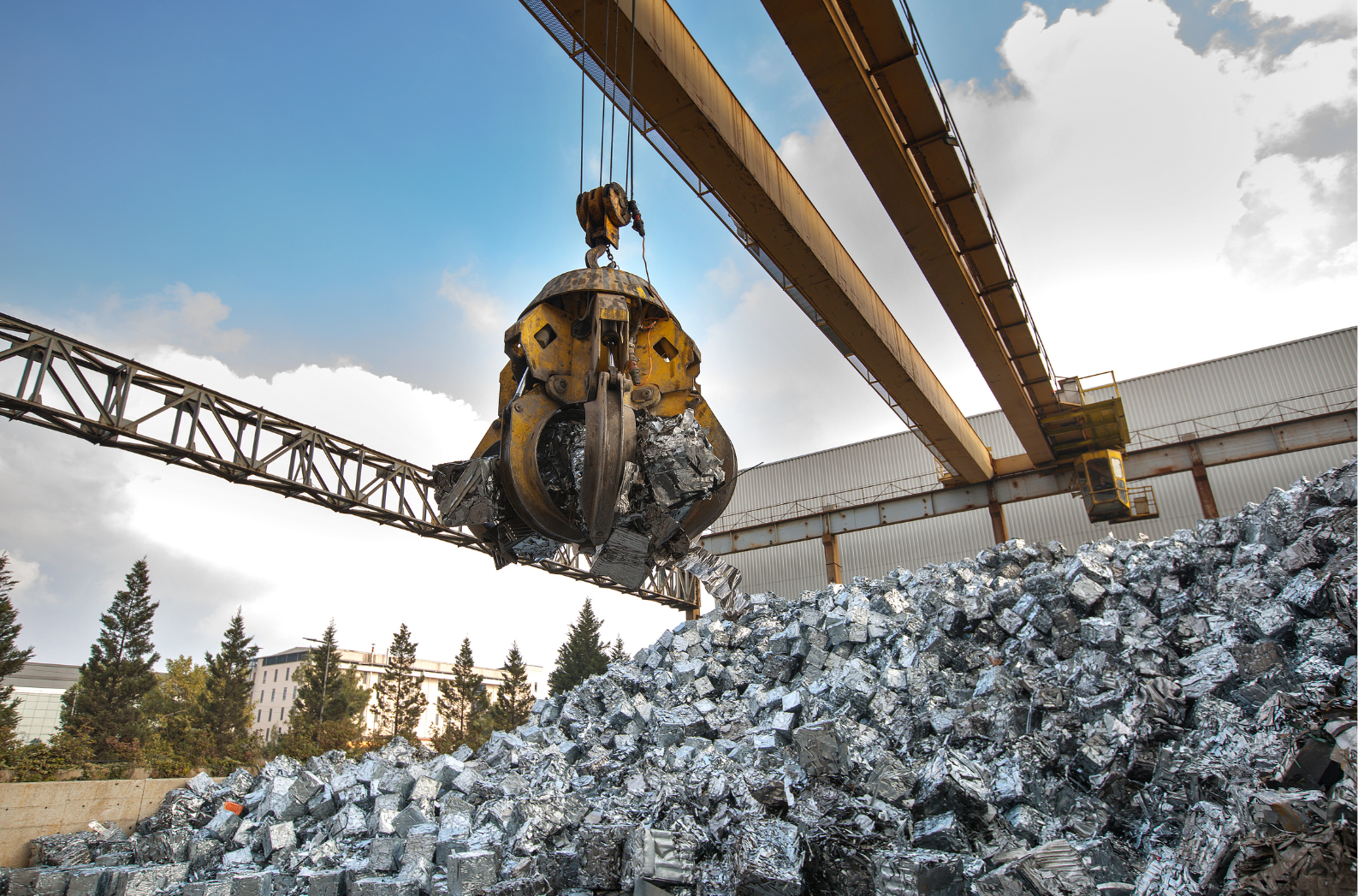
Metals are among the most recyclable materials in the world, and the vast majority of all metal waste is remelted into new products.
In Alumeco, we continuously work to prevent waste before it occurs. This means optimising our cutting procedures, reducing scrap in our production and maintaining high product quality to reduce quality issues and returns.
We also aim to lower our overall resource use by choosing packaging with a lower climate impact and reusing packaging materials whenever possible without compromising the protection of our products.
Action plan for the central warehouse in Odense
The biggest contributor to our scope 1 and 2 emissions is our activities at the central warehouse in Odense. In 2025 we have had an external company carry out an energy audit with the purpose of identifying areas where we can decrease our carbon footprint. This and previous ideas have led to the following initiatives we want to implement before 2028:
- Upgrade of our process exhaust system for better pressure control and more flexible energy usage
- Implementation of heat recovery measures in our compressor setup
- Implementation of energy recovery systems on all automated rack systems
This is estimated to reduce the energy for heat and electricity in the central warehouse by 10% and a total reduction of 85 tons of CO₂ (market based).